Launch offer — valid today only

📄 Digital book in PDF · read it on your phone or print it

Water Treatment and the State Operator Exam in Drawings The Math in the Same 4 Steps

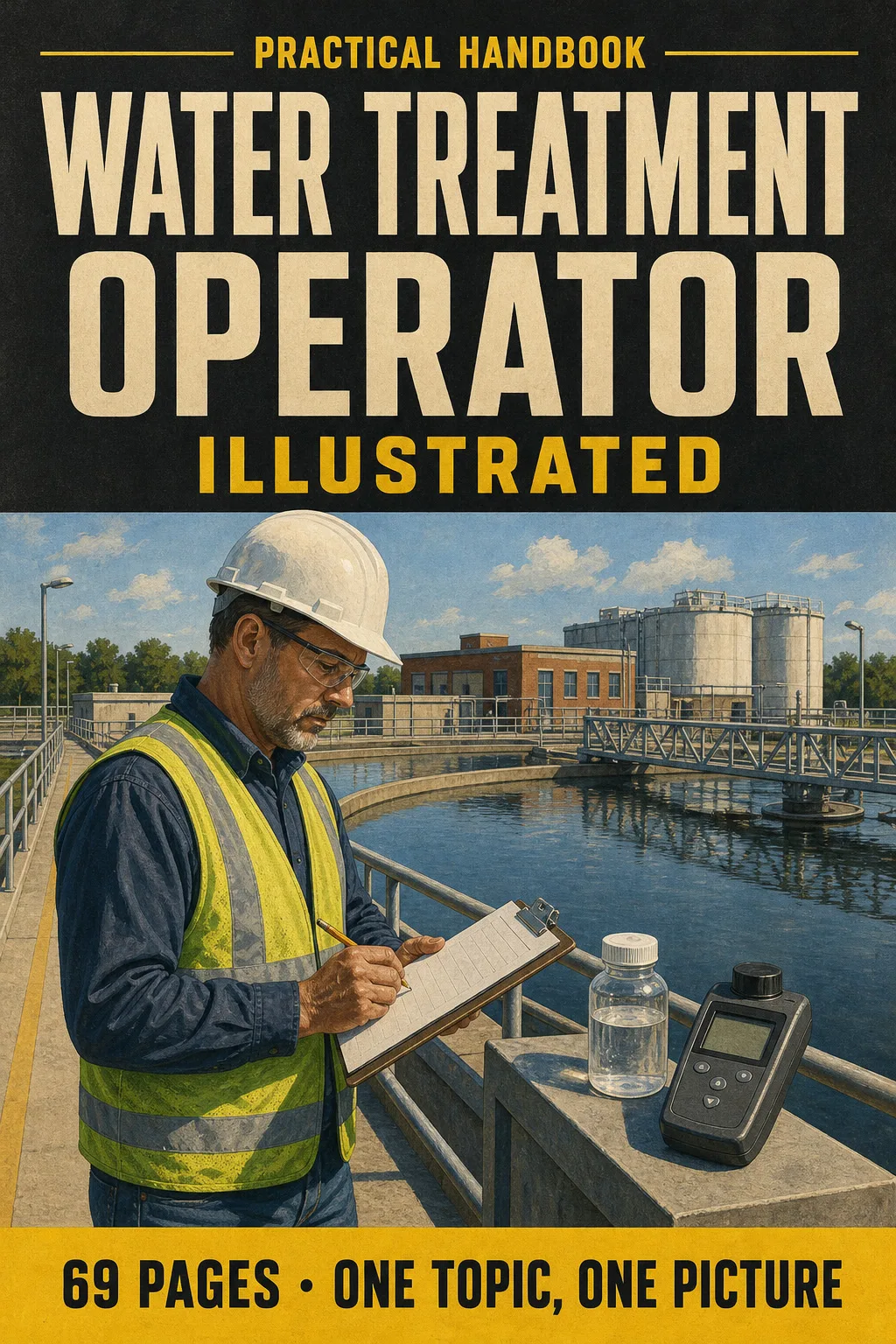
Wells, coagulation, floc, dual-media filters, the breakpoint curve, CT, pumps, sampling rules and the pounds formula. Each topic gets its own page: the drawing first, then what you need to remember. 69 illustrated pages.

START STUDYING THIS WAY

🔒 Secure checkout · PDF by email · 30-day guarantee

Every topic, its own pageEach process step and each formula drawn, with the explanation right beside it
69 illustrated pages9 parts, from the whole plant in one drawing to the last-week checklist
Up-to-date sourcesEPA drinking water rules (40 CFR Part 141), OSHA standards and your state certification program
PDF by emailFormat

Look Inside the Book

Every page has one big drawing and a box with the numbers and steps you need to know:

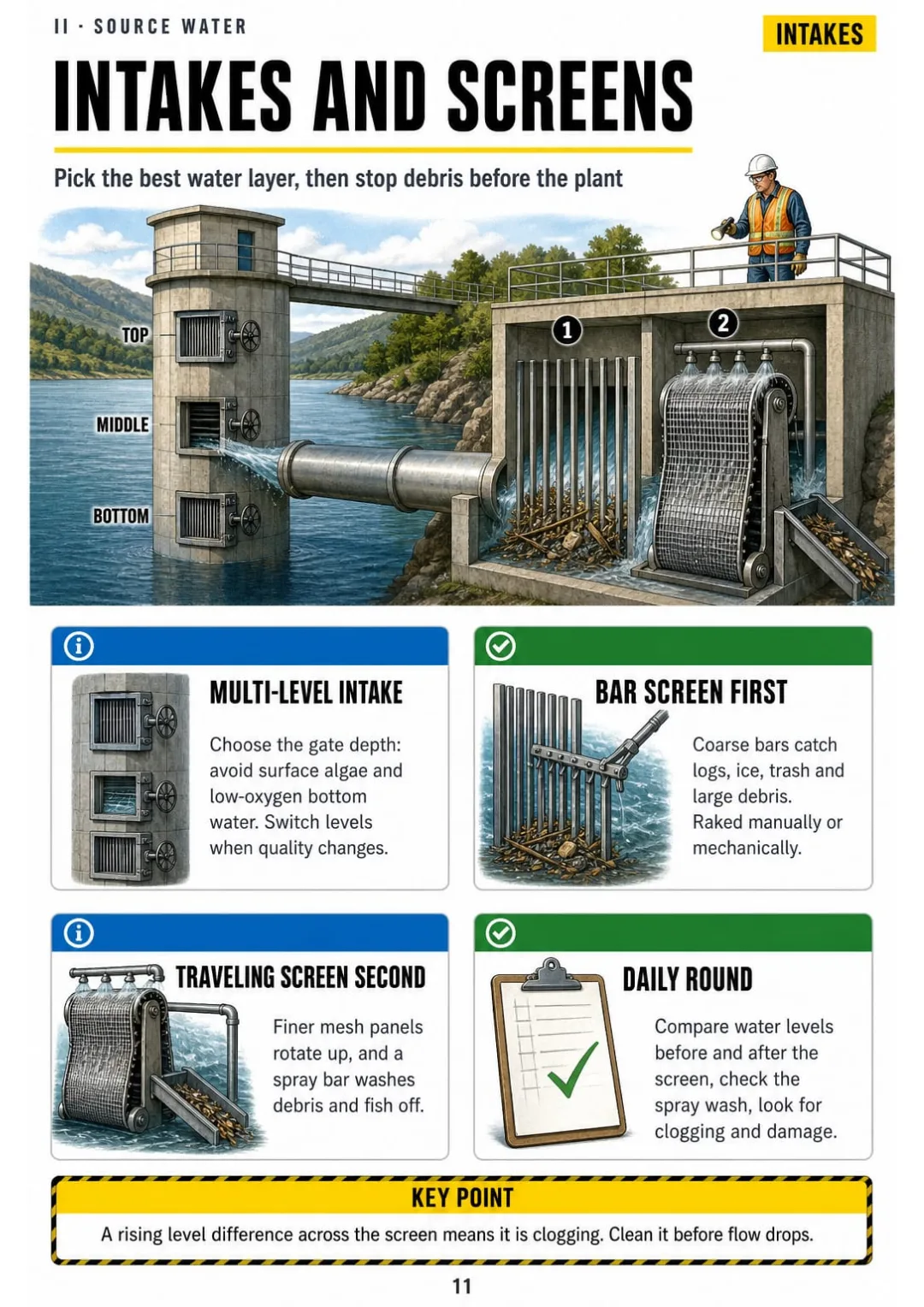
Intake tower with three gate levels, bar screen first, traveling screen second.
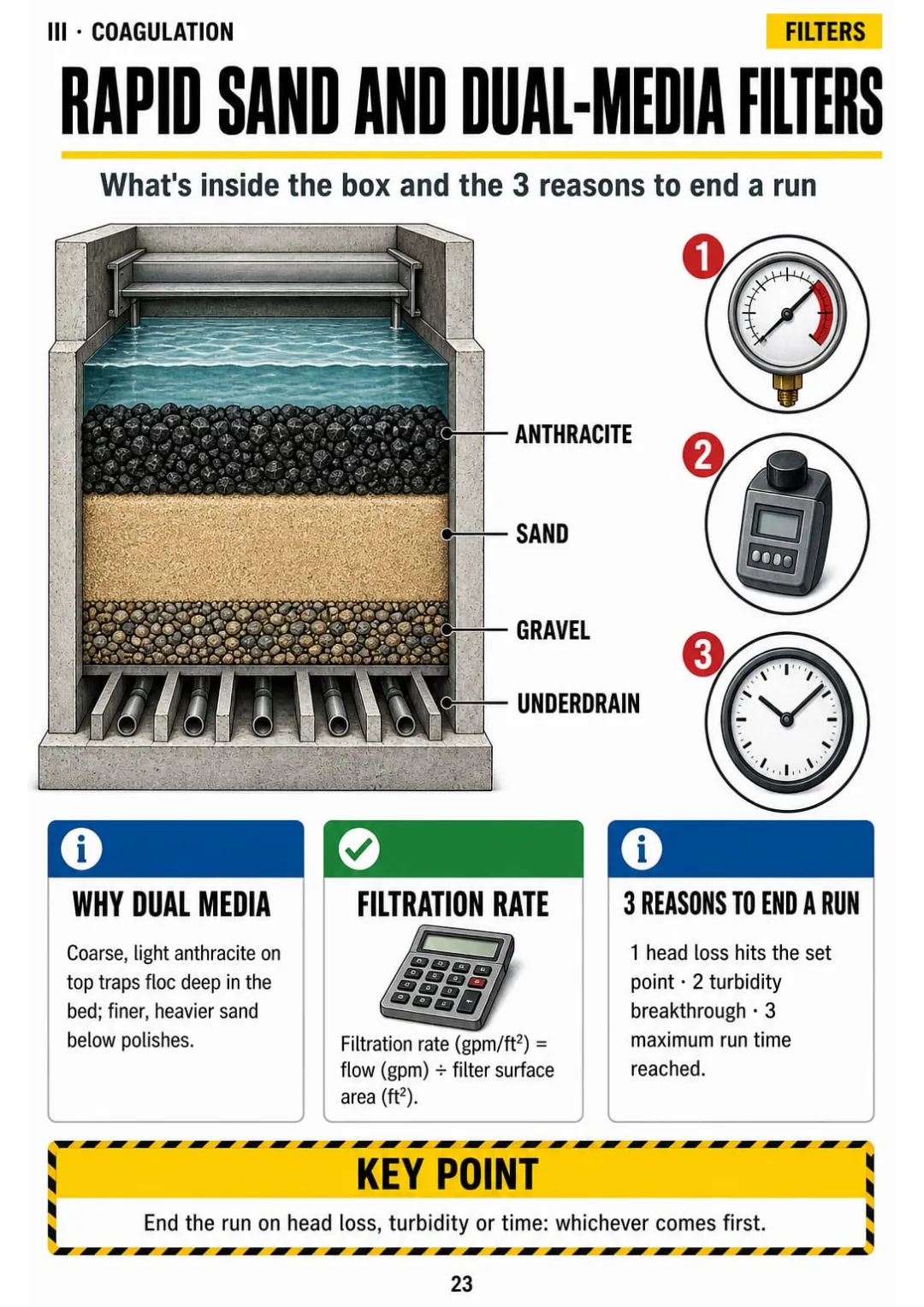
Anthracite, sand, gravel, underdrain: end the run on head loss, turbidity or run time.
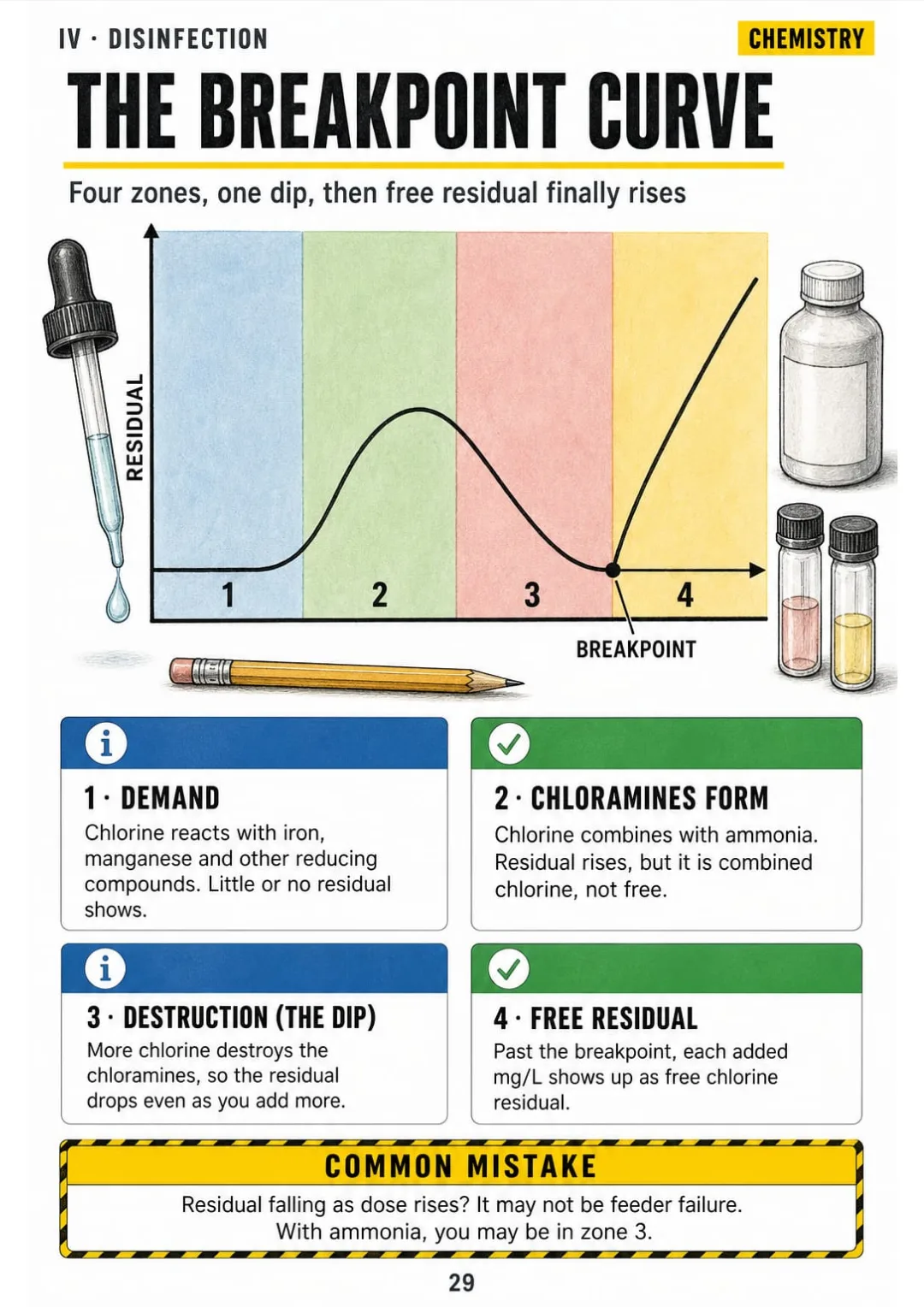
Breakpoint curve: demand, chloramine formation, destruction, then free residual.
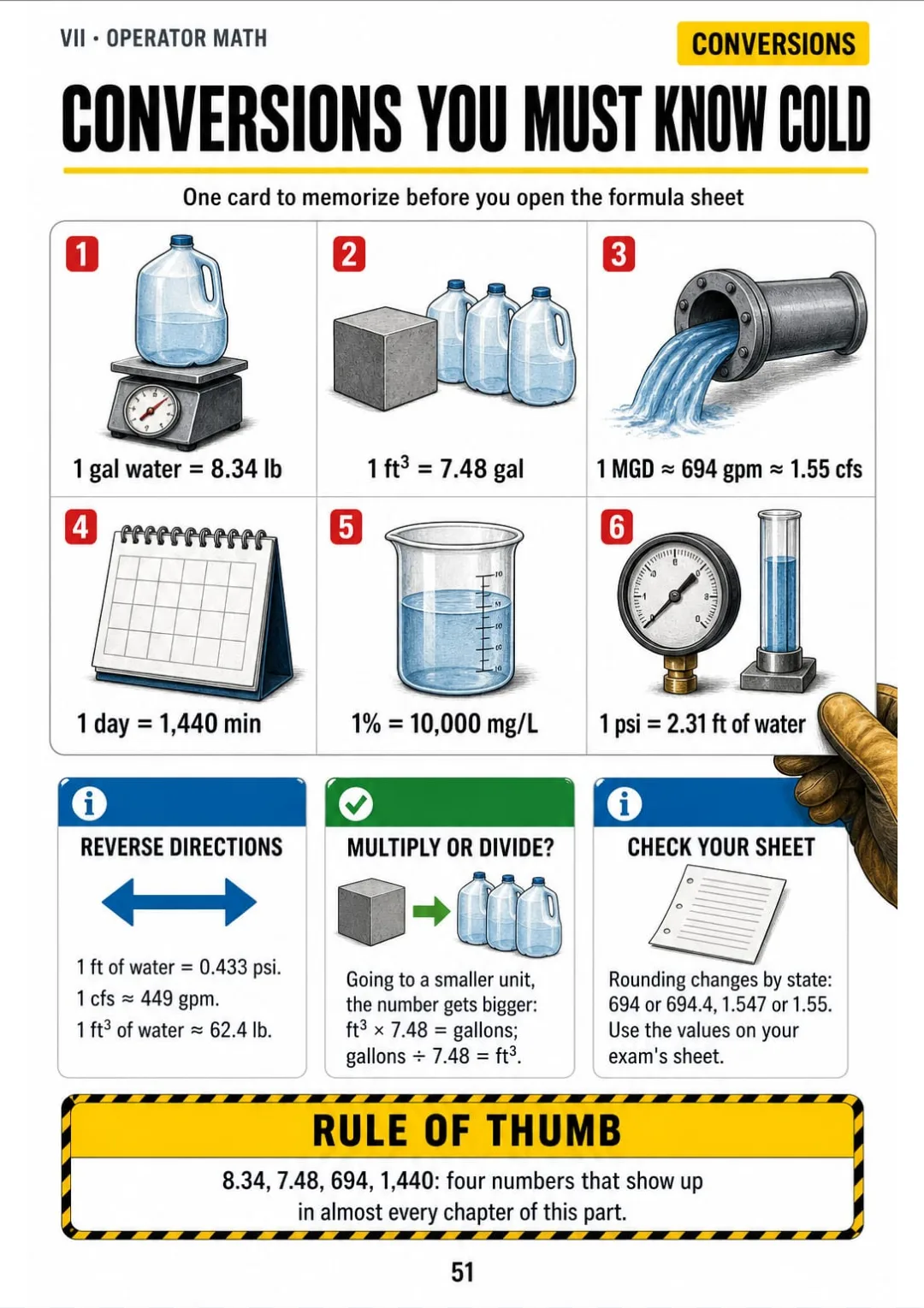
8.34 lb/gal, 7.48 gal/ft³, 694 gpm per MGD, 1,440 min/day, 1% = 10,000 mg/L
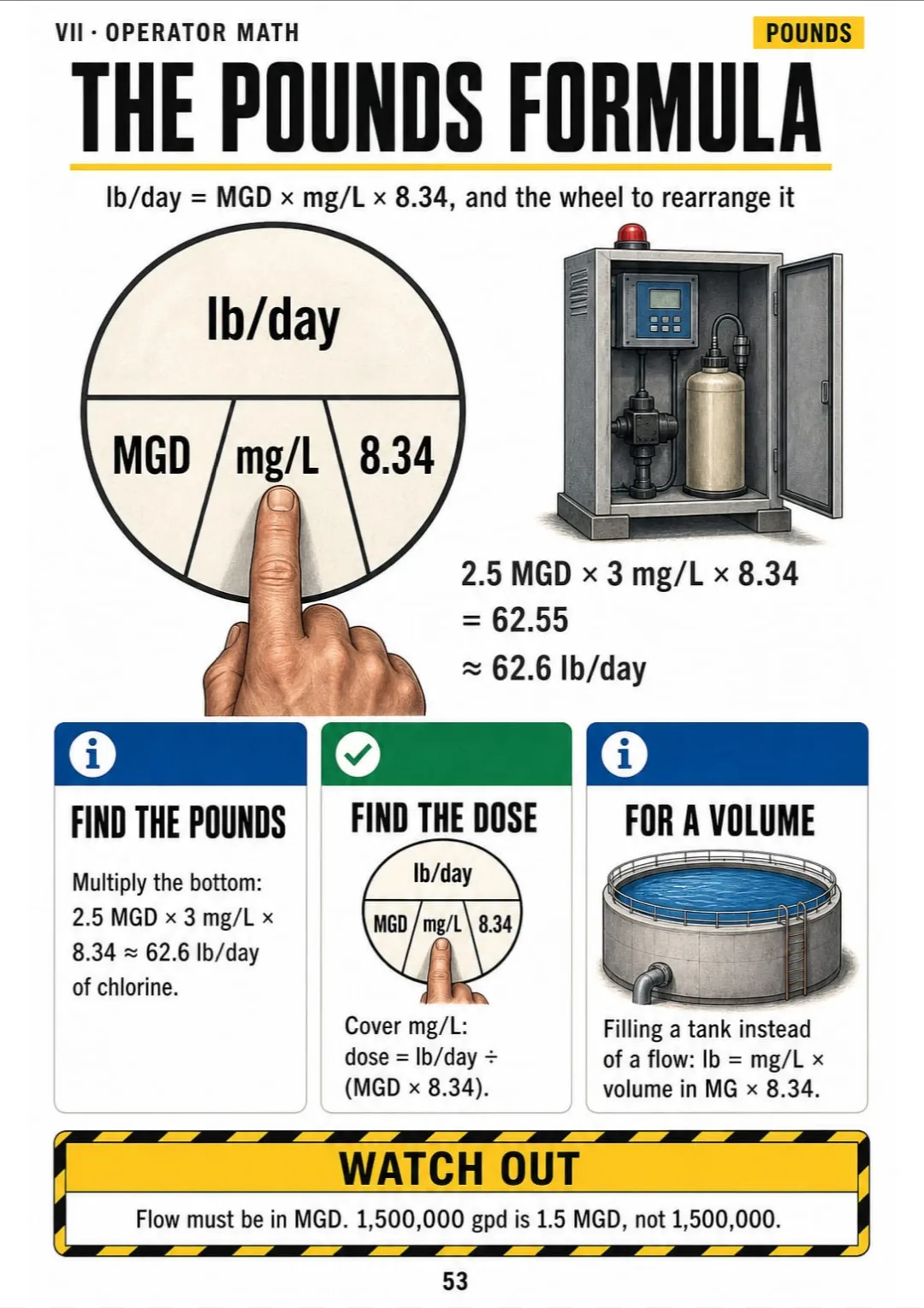
2.5 MGD × 3 mg/L × 8.34 ≈ 62.6 lb/day
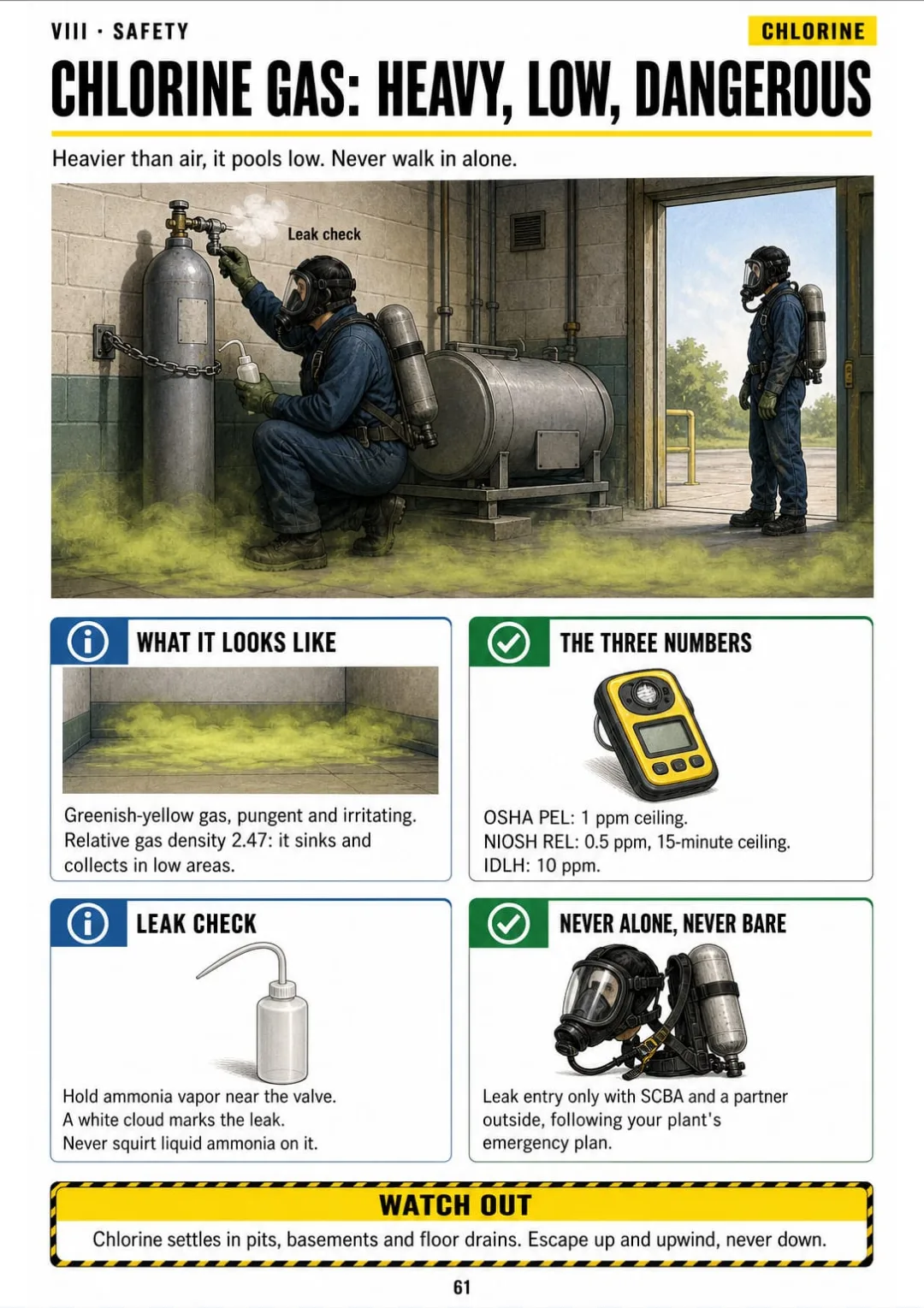
Chlorine: PEL 1 ppm ceiling, IDLH 10 ppm, density 2.47, collects low.
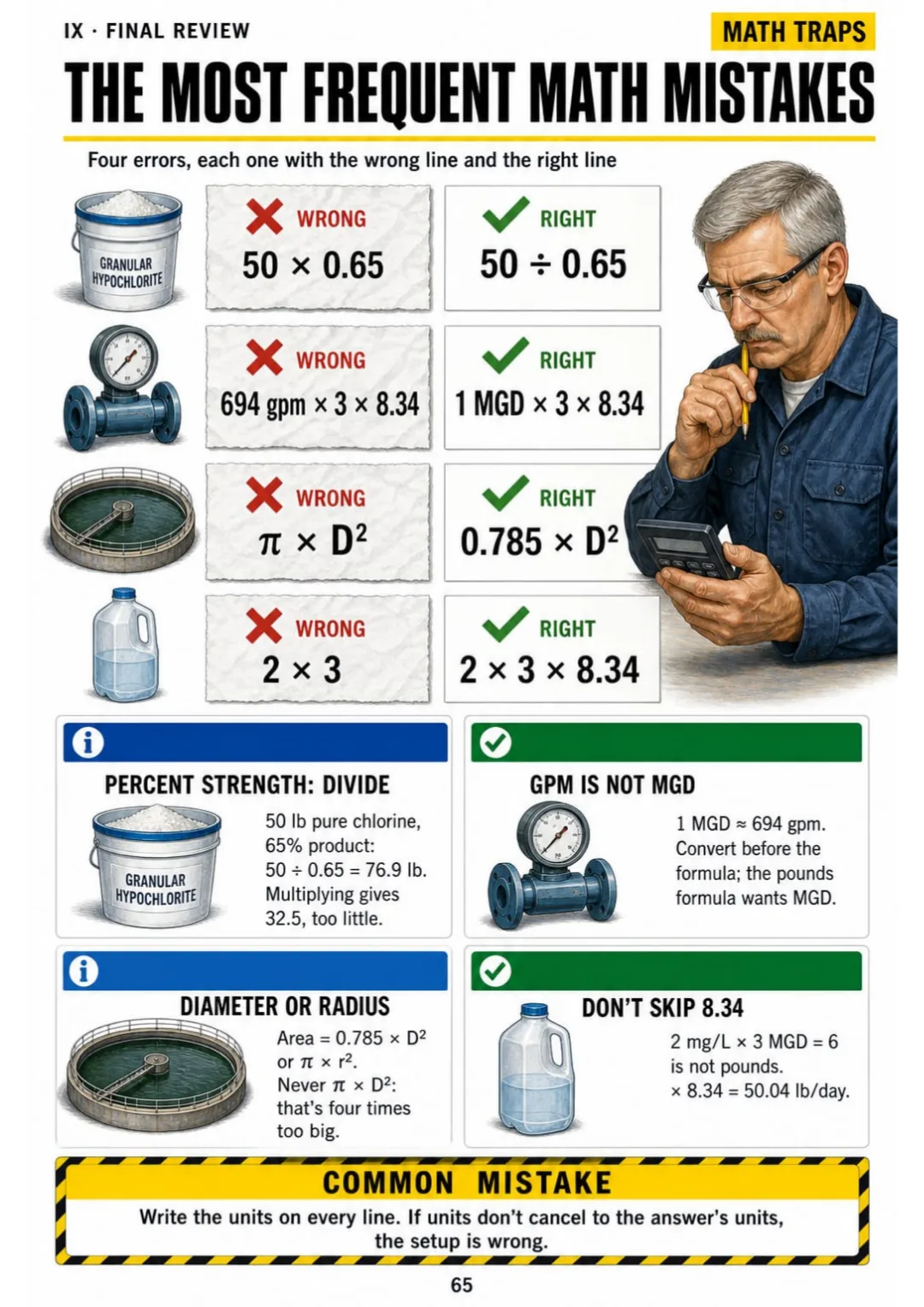
Purity divides, 1 MGD ≈ 694 gpm, 0.785 × D², and never skip 8.34.
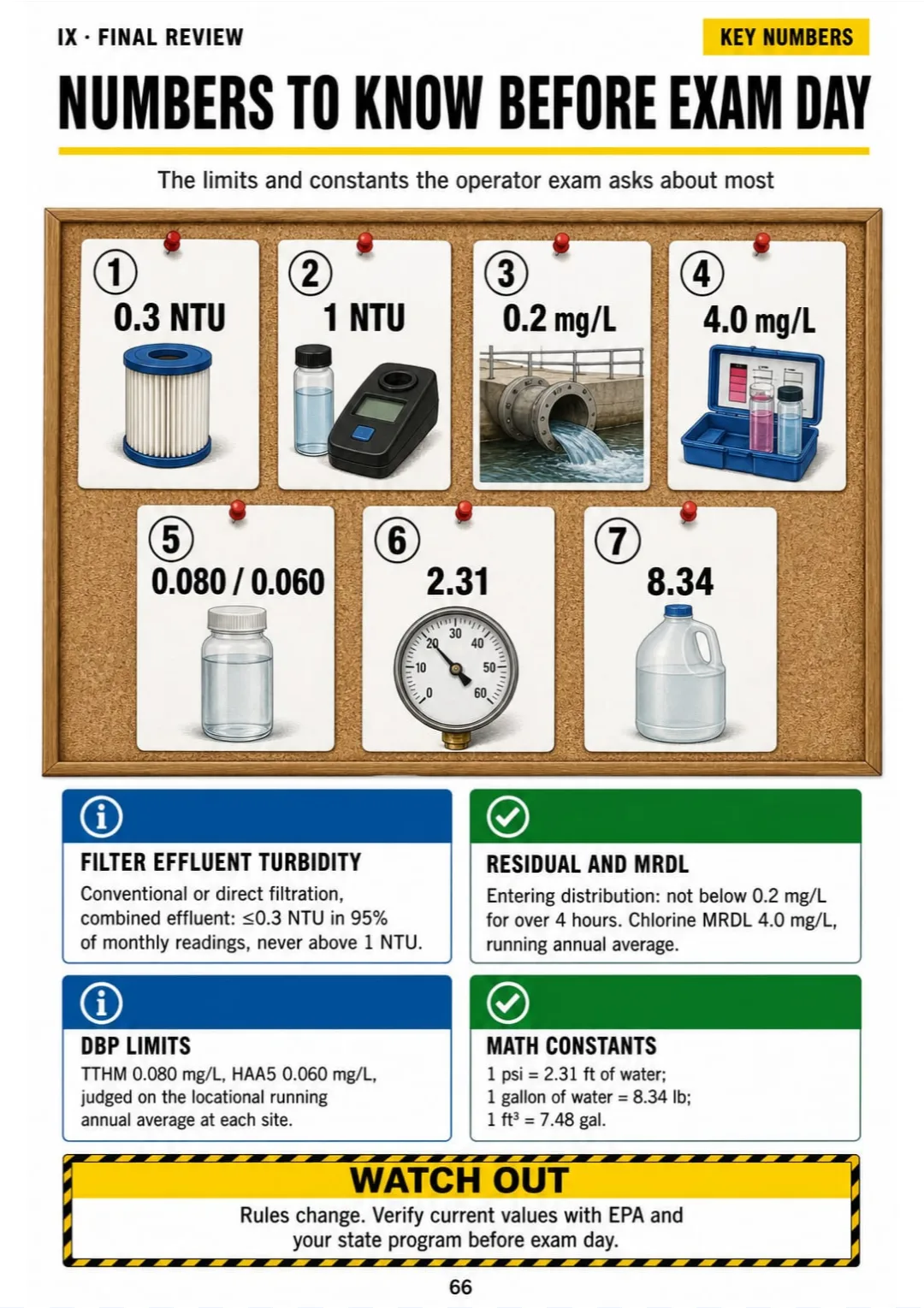
0.3 and 1 NTU · 0.2 mg/L · 4.0 mg/L · 0.080 and 0.060 · 2.31 · 8.34.

Swipe to see more →

These are real pages from the book. The table of contents is the full one: 9 parts and 65 topics.

The Problem Isn't You. It's How It Was Explained to You.

You're standing at the chlorine analyzer. You raised the dose, and the residual went down instead of up.

You open the manual: three paragraphs on chloramines, nitrogen trichloride and the "breakpoint phenomenon." Words describing a curve nobody ever drew for you.

Breakpoint curve: demand, chloramine formation, destruction, then free residual.

In the book, breakpoint chlorination is one curve on one page: demand first, then chloramines building, then the dip as they're destroyed, then free residual climbing. You can see where your water sits on it.

Same with coagulation, dual-media filters, CT, the pounds formula and lockout/tagout: each one has its own page.

You understand why the residual dropped, and you know what to check next without going back to the manual.

COMPARE FOR YOURSELF

Same Topic, Two Ways to Study It

THIS
  • The manual: line after line
  • Filter media and run limits explained only in words
  • You walk into the exam with doubts
Rapid sand and dual-media filters operate by passing coagulated and settled water downward through a granular bed, within which particulate matter is removed by straining, sedimentation, adsorption and interception mechanisms. In dual-media configurations, a layer of coarser, lower-density anthracite coal is placed above finer, higher-density silica sand, which is in turn supported by graded gravel over an underdrain system. Filter runs are generally terminated when head loss reaches a predetermined value, when effluent turbidity begins to increase, or when a maximum run time has elapsed, whichever occurs first.
FOR THIS
  • The whole filter bed in one drawing
  • The three reasons to end a run in a box
  • You see it and you get it
Anthracite, sand, gravel, underdrain: end the run on head loss, turbidity or run time.
CONTENTS

Take a Look at the 9 Parts and 65 Topics

The plant and your exam, source water, coagulation to filtration, disinfection, distribution and pumps, rules and lab, operator math, plant safety and a final review: 69 pages, all illustrated.

IThe Plant and Your Exam · pp. 5-10
  1. The Whole Plant in One Drawing
  2. Your State, Your Grade
  3. Surface Water vs Groundwater
  4. What We Remove and Why
  5. The Words the Exam Uses
  6. How to Read a Question Like an Operator
IISource Water and Pretreatment · pp. 11-16
  1. Intakes and Screens
  2. Lake Turnover and Algae
  3. Wells: The Parts You Must Name
  4. Pre-oxidation and Aeration
  5. Iron and Manganese
  6. pH and Alkalinity
IIICoagulation to Filtration · pp. 17-25
  1. Coagulation: Neutralizing the Charge
  2. Flocculation: Growing the Floc
  3. The Jar Test, Step by Step
  4. Polymers: Coagulants and Aids
  5. Sedimentation Basins
  6. Sludge and Tube Settlers
  7. Rapid Sand and Dual-Media Filters
  8. Backwash Without Losing Media
  9. Filter Turbidity Limits
IVDisinfection · pp. 26-34
  1. Why Chlorine, and What It Becomes
  2. Dose = Demand + Residual
  3. Free vs Combined Residual
  4. The Breakpoint Curve
  5. Chloramination
  6. CT: Concentration Times Time
  7. Log Removal Made Visual
  8. Gas, Hypochlorite and Tablets
  9. Other Disinfectants: UV and Ozone
VDistribution, Pumps and Storage · pp. 35-41
  1. Clearwells and Storage Tanks
  2. Pressure and Feet of Head
  3. The Centrifugal Pump
  4. Cavitation, Water Hammer and Air
  5. Valves You Will Operate
  6. Cross-Connections and Backflow
  7. Flushing and Main Disinfection
VIRules, Sampling and Lab · pp. 42-49
  1. Safe Drinking Water Act in One Page
  2. Coliform and E. coli Sampling
  3. Disinfection Byproducts
  4. Lead and Copper
  5. Nitrate, Fluoride and Arsenic
  6. Bench Tests on Your Shift
  7. Public Notification Tiers
  8. Records and Reports
VIIOperator Math, Same 4 Steps · pp. 50-60
  1. The 4-Step Method
  2. Conversions You Must Know Cold
  3. Area and Volume of Tanks
  4. The Pounds Formula
  5. Pounds with Hypochlorite
  6. Liquid Feed in Gallons per Day
  7. Detention Time
  8. Filtration and Backwash Rates
  9. Flow: Q = A × V
  10. Percent and Dilution: C1V1 = C2V2
  11. Pump Horsepower Basics
VIIISafety on the Plant Floor · pp. 61-64
  1. Chlorine Gas Safety
  2. Chemicals and SDS
  3. Confined Spaces
  4. Lockout/Tagout
IXFinal Review · pp. 65-69
  1. The Most Frequent Math Mistakes
  2. Numbers to Know Before Exam Day
  3. Words That Get Mixed Up
  4. The Plant Again, Now You Know It
  5. Last-Week Checklist

One Page, One Topic, All Clear

Think of it this way:

It's your shift and the supervisor hands you today's numbers: 2.5 MGD, dose 3 mg/L. He wants the pounds per day on the feed log.

You open the pounds formula page and it's drawn in the same 4 steps as every problem: write what you're given, pick the formula, line up the units, solve and check. Here that's 2.5 MGD × 3 mg/L × 8.34, and the worked example lands at about 62.6 lb/day.

2.5 MGD × 3 mg/L × 8.34 ≈ 62.6 lb/day

Same with the breakpoint curve, the jar test, backwash, CT and detention time: each one on its own page.

Water Treatment Operator Illustrated is 69 illustrated pages in 9 parts, and it ends with a final review: the most frequent math mistakes, the numbers to know before exam day and a last-week checklist.

What you see drawn, you don't have to memorize.

What's Inside Water Treatment Operator Illustrated:

Ipp. 5-10

The Plant and Your Exam

The whole plant in one drawing, grades by state, surface water vs groundwater, what we remove and why, and the words the exam uses.

IIpp. 11-16

Source Water and Pretreatment

Intakes and screens, lake turnover and algae, the parts of a well, pre-oxidation, iron and manganese, pH and alkalinity.

IIIpp. 17-25

Coagulation to Filtration

Coagulation, floc, the jar test step by step, polymers, settling basins, sludge, dual-media filters, backwash and turbidity limits.

IVpp. 26-34

Disinfection

What chlorine becomes, dose = demand + residual, free vs combined, the breakpoint curve, chloramines, CT, log removal, UV and ozone.

Vpp. 35-41

Distribution, Pumps and Storage

Clearwells and tanks, pressure and feet of head, the centrifugal pump, cavitation and water hammer, valves, backflow and flushing.

VIpp. 42-49

Rules, Sampling and Lab

The Safe Drinking Water Act in one page, coliform sampling, byproducts, lead and copper, bench tests, public notice and records.

VIIpp. 50-60

Operator Math, Same 4 Steps

The 4-step method, conversions, tank volume, the pounds formula, hypochlorite, liquid feed, detention time, Q = A × V and dilution.

VIIIpp. 61-64

Safety on the Plant Floor

Chlorine gas safety, chemicals and SDS, confined spaces and lockout/tagout.

IXpp. 65-69

Final Review

The most frequent math mistakes, the numbers to know before exam day, words that get mixed up and a last-week checklist.

At the end of the book: A final review with the most frequent math mistakes, the numbers to know before exam day and a last-week checklist.
Plus: 2 Free Books

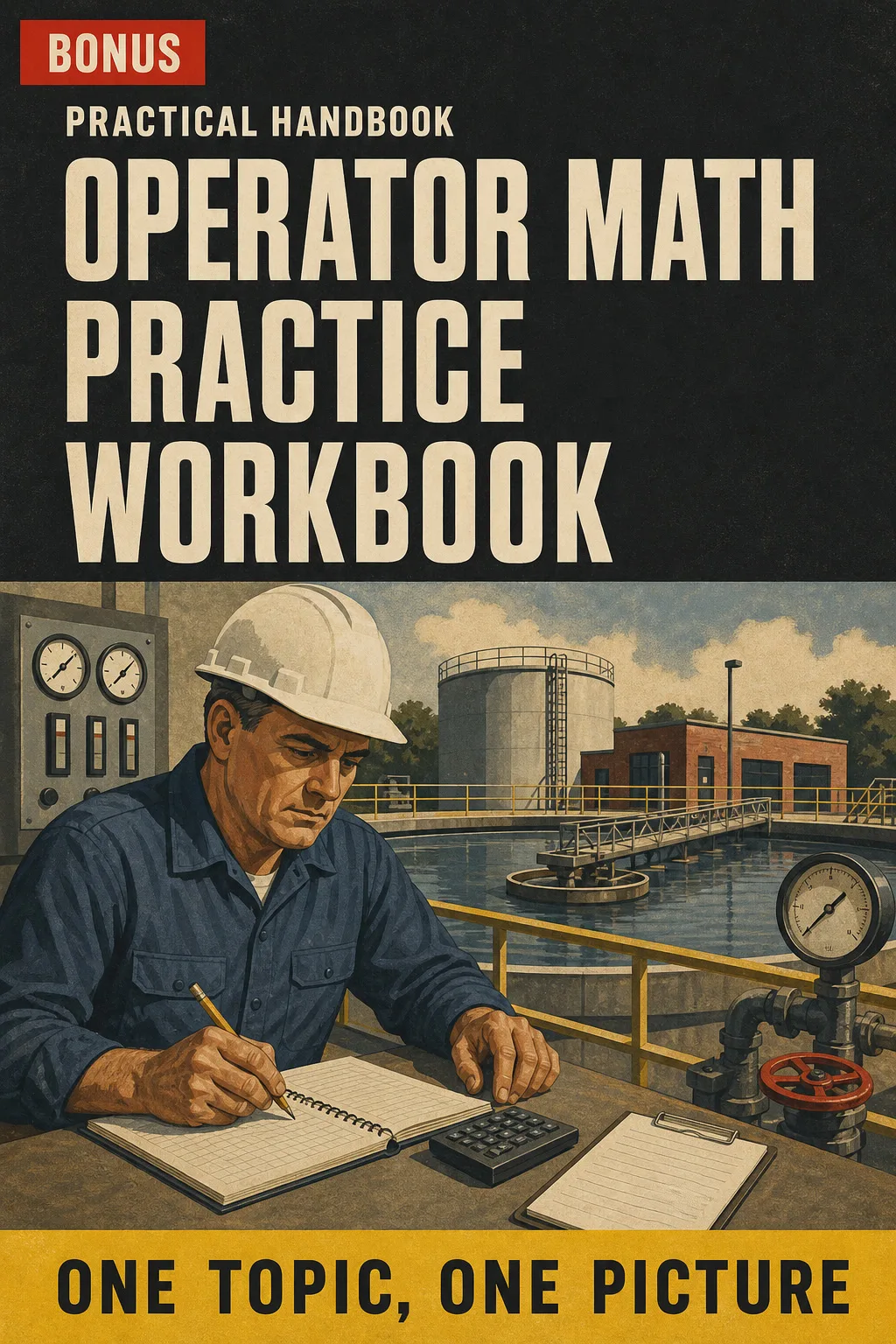
Operator Math Practice Workbook

BONUS 1: «Operator Math Practice Workbook»

Value on its own: US$ 17.90

Practice pounds formula, chlorine dose, detention time and flow problems in exam style, with every answer worked out step by step so you see exactly where you went wrong.

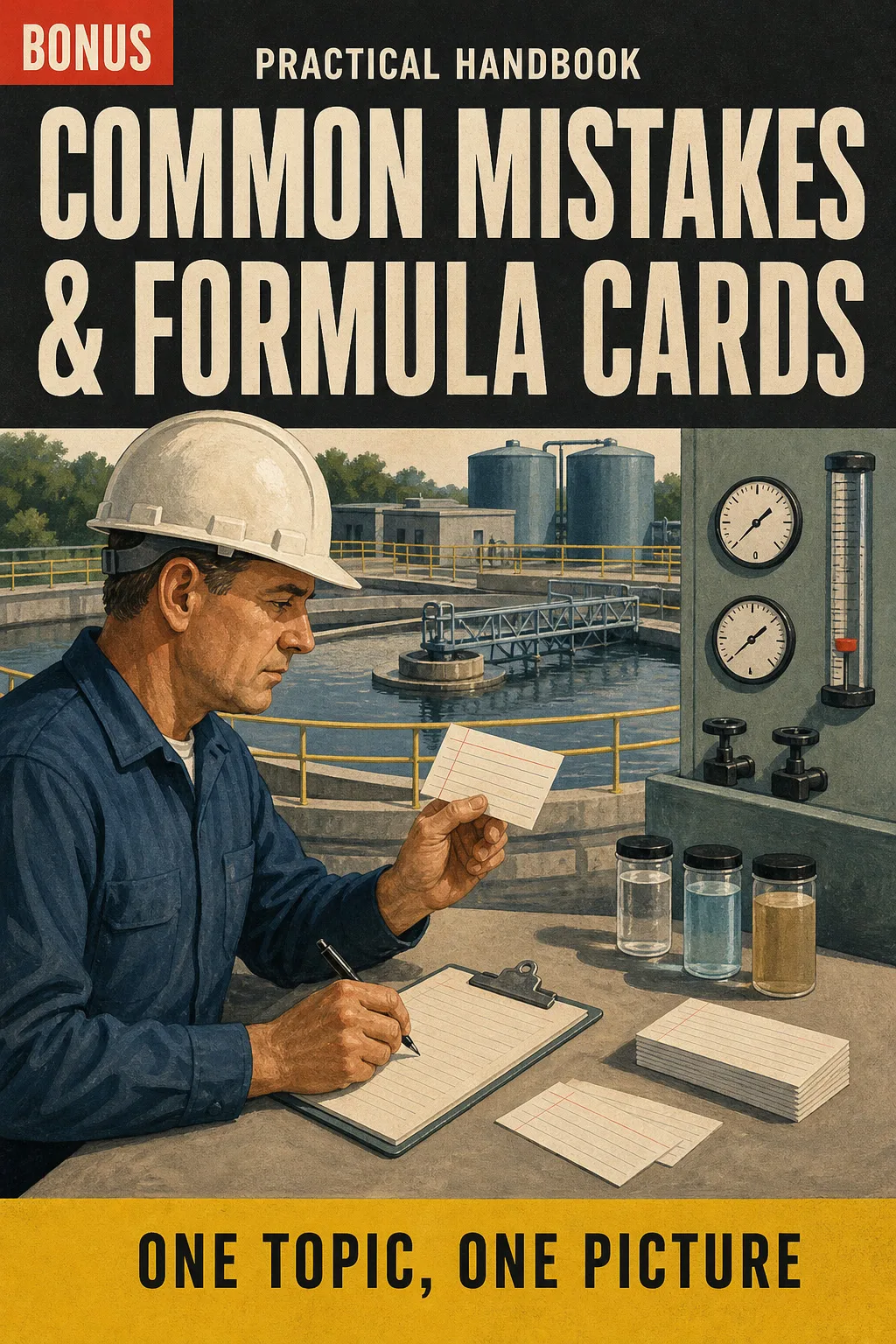
Common Mistakes & Formula Cards

BONUS 2: «Common Mistakes & Formula Cards»

Value on its own: US$ 14.90

Review the most frequent mistakes before and after, plus one-page formula and conversion cards you can print and keep at hand for the last week before the exam.

Water Treatment Operator Illustrated with 2 Free Books

  • Water Treatment Operator Illustrated: 69 illustrated pagesUS$ 63
  • BONUS 1: Operator Math Practice WorkbookUS$ 17.90
  • BONUS 2: Common Mistakes & Formula CardsUS$ 14.90
  • High-resolution PDF to printIncluded
Total value US$ 95.80
YOUR PRICE:
US$ 27
You save US$ 68.80
YES, I WANT WATER TREATMENT OPERATOR ILLUSTRATED FOR US$ 27

📄 This is a digital PDF book sent to your email: nothing is printed or shipped.

Secure purchaseEncrypted payment30-day guarantee

PDF by email: We email you Water Treatment Operator Illustrated as a PDF, together with the two free books. It's a single payment: no installments, no extra charges.

Who This Book Is For

You're an operator in training

You're an operator in training

You do the rounds every day. Now you see the whole process in order, one drawing per step, and it matches what you walk past on shift.

You already took the exam once

You already took the exam once

It's not your memory: the math came as 40 unconnected formulas. Here every problem follows the same 4 steps, with worked examples in MGD, mg/L and lb/day, and a page with the most frequent math mistakes.

You already work at the plant

You already work at the plant

Print it and keep it at hand: the breakpoint curve, the pump, the conversions and lockout/tagout, each on one page.

Everything You Get Today

US$ 95.80US$ 27
YES, I WANT WATER TREATMENT OPERATOR ILLUSTRATED FOR US$ 27

📄 This is a digital PDF book sent to your email: nothing is printed or shipped.

30DAYS
GUARANTEE

30-Day Guarantee

Try Water Treatment Operator Illustrated for 30 days, bonus books included.

We refund everything if the file won't open, if the book isn't what you see here, if you were charged twice or if the email doesn't arrive. Just email us.

You pay once. No subscriptions.

Frequently Asked Questions

Is it for me if I'm an operator in training with a state exam coming up?

Yes. It's written for adults preparing for an entry-grade drinking water treatment operator exam (called Grade I, Class D or Class 1, depending on the state), in US units: gallons, MGD, mg/L and lb/day. The federal rules and the plant math are the same in every state. What changes is the grade name, the exam format and some state limits. Part 1 shows how grades are named by state, and every rule and number is marked so you can check it against your state program.

Where does the content come from?

From the EPA drinking water rules (40 CFR Part 141), OSHA standards on lockout/tagout, confined spaces and respirators, and state certification programs. Every rule and number is marked so you can check it against the current version.

Is this official material?

No. It's an independent illustrated study book. It isn't issued, approved or endorsed by the EPA, any state agency or any exam provider.

Does it replace my training course?

No. It doesn't replace your course, your on-the-job hours or your plant's procedures, and it doesn't give you a certificate or training hours. What it adds to the manual you already have: each topic on one page with a drawing, the math worked step by step in MGD, mg/L and lb/day, and a final review of the most frequent math mistakes. You keep it next to the manual to see what the manual explains in paragraphs.

Are the practice questions the ones on the exam?

No. The practice problems are written for this book, in exam style. They are not official questions from any exam.

When and how do I get it?

As a PDF by email, to the address you enter at checkout. The 2 bonus books come the same way.

Do I have to pay every month?

No. It's a one-time payment. No subscription.

Can I have it on paper?

Yes. The PDF is made to print, at home or at a print shop, so you can take it to the plant.

How does the refund work?

You have 30 days. We refund everything if the file won't open, if the book isn't what you see on this page, if you were charged twice or if the email doesn't arrive: just email us.

Before You Close This Page

No more rereading the manual with nothing sticking.

The breakpoint curve: you see it drawn, and that's it.

You walk into the exam knowing where everything is.

Drawings make studying faster.

The book is right below.

One-time payment: US$ 27 · Guarantee: 30 days · PDF by email

YES, I WANT WATER TREATMENT OPERATOR ILLUSTRATED FOR US$ 27

📄 This is a digital PDF book sent to your email: nothing is printed or shipped.